


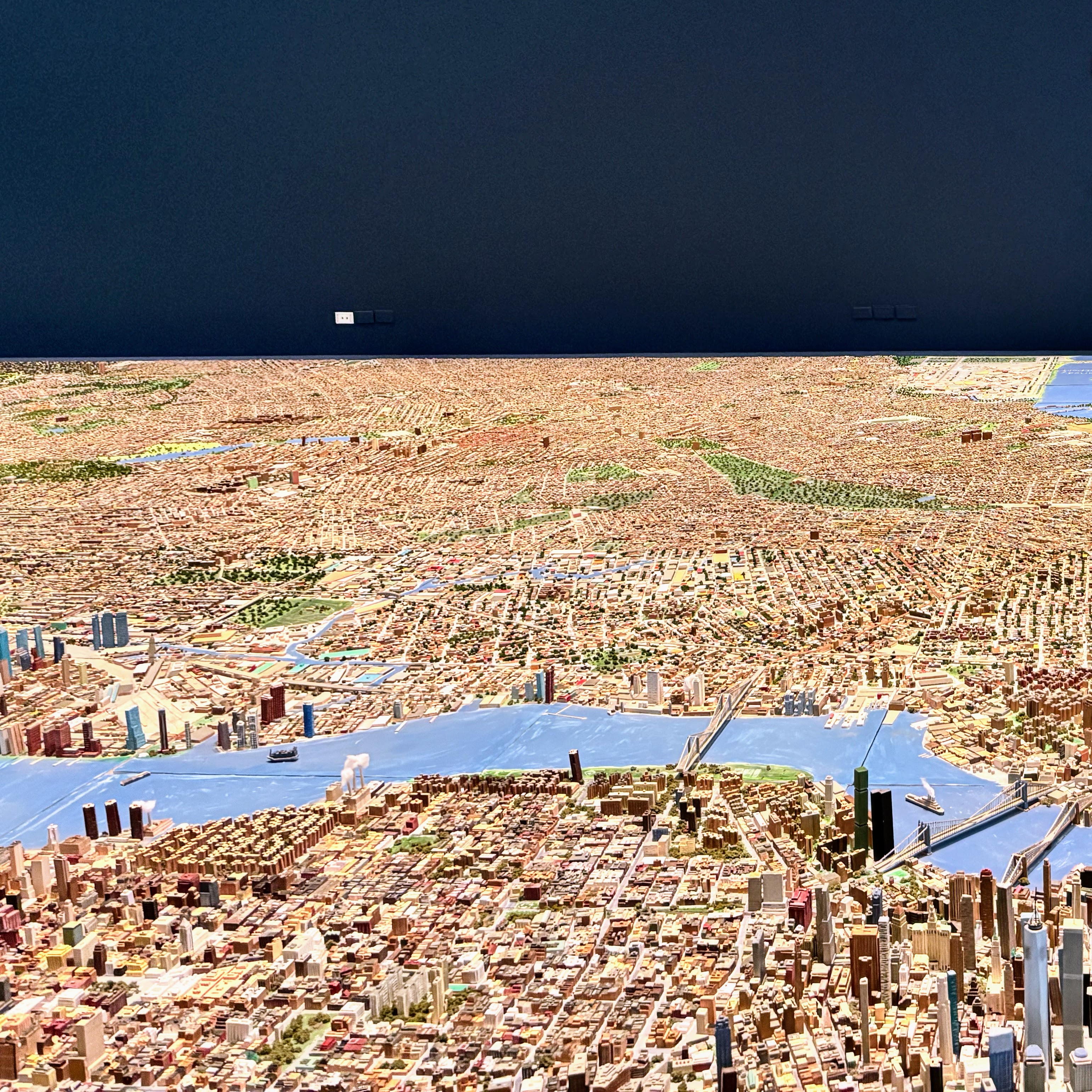
Since my last post, AI image generation has improved to the point that there's no charm in it anymore. Instead enjoy this very real photo of the very, very real exhibit He Built This City: Joe Macken's model of New York, built to scale in balsa wood and glue.
This weekend I finally had the chance to play with these new AI agents a bit more, specifically Instinct. If you’ve had any eyes on my LinkedIn, first off sorry, and secondly you'll know that here at The Zebra we have spent the last two weeks playing around with Meta’s new Muse agent. This weekend though I had a chance to explore how Instinct would fit into my own chaotic, dad of two kids, life.
First a note of disclosure: I both enjoy playing with new technologies as they come out and I am deeply skeptical of them. As a decidedly non-technical operator, I find getting into the weeds of these new technologies to be a fun challenge and a rare chance to “skill build” as a dad in my late 30s with no interest in golf.
And AI, for what it's worth, has made setting these tools up vastly more accessible for non-technical people. In March I set up a Clawdbot, Horatio, running remotely via Tailscale on a junked old Mac sitting in my closet. I mostly used it to check March Madness scores and play with my home IoT from vacation. Nothing earth-shattering, but it was a fun project that left me with the vague feeling like I was working around the margins of something big.
Testing out Instinct this weekend, that “something big” feeling came back. Within about 5 minutes of getting invited (thanks Isabel) and set up, I had booked flights and a hotel for The Zebra’s next board meeting and registered a warranty for a new stroller—a chore I had been extremely putting off. I did it all via iMessage and it all happened asynchronously while I puttered around Whole Foods.
But back to the disclosure: I'm not a starry-eyed optimist about new technology. That’s why this feeling “oh something big might happen here” is surprising to me—surprising enough for me to write about. I find cryptocurrency deeply goofy, I only messed around with NFTs so I could flip NBA Top Shot moments before the bottom fell out, I never took the metaverse seriously (duh), and I still view a lot of the hype around AI with a grimace.
Hater disclosure delivered, now I gotta say: I can't stop seeing parallels between this moment and the personal computing revolution of the '80s and '90s.
It's such a cliché to bring up, but think about that original Macintosh promise: “The computer for the rest of us.” Apple delivered computing that was accessible to everybody, human-oriented, and didn't require high degrees of technical skill. Then I think about my own experience, from poking away with the help of Antigravity over two weekends just so I could set up a clumsy, very limited Clawdbot, to today, when I signed up for Instinct and booked a flight via iMessage a few seconds later.
What we're seeing now might be the start of an “impersonal computing” revolution then, to coin a phrase: A move towards an even wider abstraction between what technology does and how users interact with it.
Registering this Bugaboo stroller warranty was a great example of this new style of impersonal computing. Abstracted under the veneer of iMessage, my Instinct agent initiated and navigated multiple layers of compute on its mission to register a warranty. All of it was invisible to me—no loading screens, no forms, no mouse clicks, no copy and paste—just a text message, a delay, and a confirmation (with the email from Bugaboo landing in my inbox).
The simplicity of this new mode isn’t worth writing about just because of the change in interface though. It’s interesting because it signals a change in the relationship between users and all of the companies and industries that have intentionally kept friction in their digital (or even retail) experiences.
Annie Lowrey named this friction the “time tax.” Generally speaking, companies who want customers to use their service more or buy their product more have used technology to make that transaction easier. It's very easy to swipe and tap on Instagram and buy baby clothes (I can attest), for example.
But somehow, this digital convenience has not progressed universally—still in 2026, many things aren't much more convenient at all. Registering for social services in the US remains incredibly time consuming, even online. Paying a parking ticket or finding out literally anything about your health insurance is still a total chore, even though we all know it could be so much easier. This is the time tax.
But now we're in an interesting little pocket of time, before the twin wheels of bureaucracy and the profit motive turn (and they will), where AI agents are showing us a different way in the world. These little suckers are purpose built to help us dodge any time tax. Industries that have long benefited from this tax, and retained dollars because of it, now face the risk of an army of autonomous, 24/7 agents coming to bash through those obstacles on behalf of their users. Why waste your time overcoming the friction that the US banking system depends on when your agent can trigger a bank run on its own?
(This raises the question: what closes the window on this moment in time then? I have a guess. I'll get there.)
So where does this all land in terms of consumer behavior and the internet?
To keep borrowing terms, I think we'll end up with a “K-shaped” internet. On one arm of the “K,” we’ll have a “process” internet. An internet for things that are fun to actually do: looking up recipes, following rabbit holes on Wikipedia, scrolling Instagram. Then we'll have another arm—an arm where agents work mostly unseen, bashing through tasks tied up by the time tax: auto insurance purchases, which are near and dear to my heart; tax filings; setting up a warranty; checking a health insurance claim. These are transactions that companies never made simple, or even intentionally injected friction into, because it had some benefit to them and not the customer.
But don’t take my word for it. As Google moves, so does the internet, and I think Google is tracing a “K.”
On one arm, SEO expert Lily Ray is predicting a massive search update. She cites Google’s recent rewrite of its own guidance on what counts as good content (effort, originality, skill) and predicts punishment of things like mass-produced AI text and fake authors with AI-generated headshots. To me, that points towards an update that reinforces the "human" or "process" internet (and remember, this part of the internet feeds the LLMs).
But along the other arm, Google also quietly killed the Spark brand. Spark was Gemini's autonomous, 24/7 background agent, predating Muse or Instinct. Until a few days ago Spark was accessible by a button labeled "Switch to Spark.” Now there's just a toggle under the prompt box: Chat or Task.
That looks like a K taking shape to me. Search is process, being optimized for humans (and agents), and reinforced by human content. Tasks are outputs. Boring, annoying things that you just need done. Also it’s possible Google is just randomly renaming things which, given their track record, is pretty likely.
And the less technical and more abstracted these new agent tools get, the more the second arm of the K becomes a really different version of the internet. In March, I needed two weekends, Antigravity's help, and a decent amount of work via the command line to get Horatio to check basketball scores. Yesterday I texted a photo of a receipt and I got a confirmation of a warranty in my inbox. I never opened a browser, switched tabs, or touched a mouse. Nothing about that experience felt like “going on the internet” at all.
At the extreme of one possible future, this might be the first time, in wave after wave of wild and goofy technology claims (Bitcoin, the metaverse, NFTs), that we actually see a real change to consumer behavior. We might not! But it's the first time I (a random guy) have entertained the idea that one of these technologies could be remotely interesting (that’s why I’m writing about it).
I don’t think the time tax is going to go away quietly though.
The time tax today is paid in a denomination of friction, but it will be rebalanced into a new currency (not tokens—tokens aren't legible to normal people, as much as AI boosters want that to be true). I think the new currency will be privacy, or personal disclosure, or possibly and more precisely “current and accurate personal information.”
I can talk to computers through iMessage now. No desktop, no terminal, no browser. But at the same time, in that conversation I'm handing Instinct a ton of personal information (my date of birth, my address, etc.) so it can transact on my behalf. The underlying exchange of information hasn't changed. You still need to share your gender identity to buy a flight and your VIN to get car insurance. What's changed is where it is collected (often via inference) and where it goes.
I'm now feeding it into a system of record that, one, has memory, so it'll remember next time; two, has contextual awareness, so it can pull information from non-traditional sources (like a photo of a receipt); and three, if I’m honest I’m way more comfortable with, because all I’m seeing is iMessage and not random UI. Entering my VIN on progressive.com is high-trust. Entering it on joesinsuranceshack.com is low-trust. Instinct might just do both for me because it is focused on the output, not the process.
So here's my bet, at the extreme: the new tax won’t be paid in time. It'll be paid in privacy—a constant demand for personal information to help these agents complete their tasks.
What about this current “pocket of time” though where agents can just bash away at a task, slurping up personal info and stomping around the human internet? Well like I said, those twin wheels of bureaucracy and the profit motive will keep turning and I have a guess at where they’ll end: liability.
Reading the FT piece on OpenAI's legal headaches this weekend sent me back further than the Mac, to an even more cliché analogy: the automobile. I think the potential of these agents will eventually be capped by how much liability society, and more importantly the financial services industry, can get comfortable with. This will be a power struggle of course. Never forget that the automobile companies have consistently lobbied against safety regulations.
But my prediction is that agents will end up being managed a lot like automobiles. There will be a form of operator liability, which falls on the driver or the human agent owner, and then there will be a form of manufacturer liability, which falls on the OEM, or here, whoever built the agent.
Right now, I’m going to enjoy this little window of relatively unconstrained exploration. Over the next five years though, I’ll wager we’ll see much more strictly enforced contracts between agents and the sites they use, the way highways got speed limits and manufacturers were made to start safety testing. Either way though, I do think for the first time in a while we’re on our way to a big shift in how consumers act.